







This rapidly growing segment of the population is gaining ground in business
There is a strong entrepreneurial spirit among Hispanic women, with more and more owning and operating businesses, both large and small. Latinas own more than 1 million businesses in the U.S., and 1 in 10 of all women-owned firms in the United States is owned by a Latina.
The Latina Entrepreneur
Latina owned businesses are also growing at a much faster rate than businesses for all women—over 200 percent versus 32 percent between 1997 and 2014. Over the past 17 years, the number of Latina-owned firms has more than tripled, employment has risen 85 percent, and revenues have more than doubled (106%)—in comparison with 68 percent firm growth among all women-owned firms, 11 percent employment growth among all women owned firms, and 72 percent revenue growth among all women-owned firms. In 2014, Latina businesses employed over 400,000 persons and contributed over $71 billon to the economy. Yes, Latinas are on the rise.
They are establishing businesses, taking on leadership roles and becoming ever more visible in every facet of business. Meet just a few of the influential Latinas who are doing remarkable things in the world of business today.
Geisha Williams of PG&E

Geisha Williams is the new CEO and president of Pacific Gas & Electric (PG&E) Corporation. She is the first woman to take such a position at the company, and assumed the role just this month. Williams, a 55-year-old Cuban immigrant, is also the first female Hispanic CEO of a company as large as PG&E.
“We applaud Geisha Williams for breaking a glass ceiling in corporate America,” said USHCC President & CEO Javier Palomarez. “This signals a new beginning for the utility industry. It shows that Latinas too can earn command of Fortune 200 companies.”
Williams played a key role in handling the planned shutdown of PG&E’s Diablo Canyon nuclear plant and oversaw PG&E’s shift to getting nearly 30 percent of its energy from renewable sources.
Carmen Castillo of SDI International
Carmen Castillo is the founder, President and CEO of SDI International Corp., one of the largest certified minority- and woman-owned Procurement Outsourcing Organizations in the world. The company provides its clients with fully scalable global indirect procurement solutions (tail-end) centered on Procure-to-Pay and Source-to-Pay.
These programs are designed to manage large numbers of small suppliers handling non-critical/non-catalogue transactions that are often untracked, resulting in inefficiencies in process times, compliance and costs. SDI has distinguished itself as a provider of robust process efficiencies, driving repeatable hard cost savings through cutting-edge technology, risk assessment, quality policies and a dedicated team, fostering long-standing business relationships with its Fortune 500 customers.
Rosa Santana of Santana Group

Rosa Santana is the founder and CEO of the Santana Group, a group of companies providing innovative outsourcing solutions to organizations across all industries. Based in Texas, Santa is an entrepreneur and business leader who, for over 35 years, has been a driving force within the U.S./Mexico staffing industry. She is recognized internationally as a human capital solutions expert.
Santana is a fearless leader who harnesses her passion to successfully create and develop companies through impeccable client service and innovative business solutions. As a visionary trailblazer, Santana’s unwavering integrity has established her staying power and success throughout the course of her remarkable career. Santana Group companies include Integrated Human Capital, Workforce Management Mexico, Diversa, Forma Automotive, and Oveana Global Business Services.
Gaby Natale of AGANARmedia

A six-time Emmy nominee—and 2015 winner—mediapreneur Gaby Natale is the host of SuperLatina, the syndicated TV talk show. She is also the co-founder and president of AGANARmedia, a content development and grassroots marketing company with a focus on Hispanic audiences.
Natale is one of the few women in the entertainment industry who owns not only the rights to her TV show but also a television studio. This unique situation has allowed her to combine her passion for media and her entrepreneurial spirit.
In the digital world, Gaby has developed her own online fan base, with over 40 million views on Youtube (growing at a pace of 1 million per month) and 25,000 Twitter followers @superlatinashow.
A Powerful Force
With Latina-owned businesses are the fastest-growing business segment in the United States, we will continue to see these strong women grow and thrive, contributing significantly to our nation’s economy. The power of their combined efforts is a force to be reckoned with!
Sources: nwbc.gov, bls.gov, doe.gov, ushcc.com, gabynatale.com


Starting education initiatives early
To truly set women up for success in their future workplaces, change must start in schools – and not simply in terms of curriculum.
“We need to address sexism in the workplace that makes girls and women feel they don’t belong, or are not good enough,” said Andrea Navarro, News, Mexico City deputy bureau chief and a volunteer for our Financial Literacy workshop in partnership with Mexico’s non-profit Interactive Museum of Economics (MIDE). Last year, we launched an annual financial literacy program to support young women interested in learning about personal finance and the economy. This year, more than 150 young women attended.
“It’s often said that men are better suited for careers in finance and STEM,” Navarro added. “That discourse desperately needs to change and we need to highlight the historical contributions of successful women so younger ones can see for themselves what’s possible.”
Halfway across the globe, similar outmoded gender narratives can keep girls from even considering studies in tech and finance.
“In Japan, some parents still say, ‘You are a girl so you don’t need to be good at math or science,’” said Noriko Suzumura, Sales, Tokyo, a volunteer with Corporate Philanthropy partner Junior Achievement, a Nobel Peace Prize-nominated program providing lessons in financial literacy, work and career readiness, and entrepreneurship. Alumni of the Junior Achievement program have been shown to be more likely to have a college degree, feel confident about managing money, have successful careers, and to have started a business as an adult.
“Students in Japan are required to select either the ‘science’ path or the ‘liberal arts’ path at the age of 15, and once selecting ‘liberal arts,’ it’s difficult to change paths,” Suzumura added. “Changes can happen at home amongst families if adults can show role models and actual examples of successful women in finance. Changes can also happen at school, and of course, at the government level to implement a system to encourage more girls to proceed into such fields. We all can empower and encourage girls and women by speaking and working with them through volunteering.”
At Next-Gen Connect, Junior Achievement’s female university students across Asia, Europe, and the Middle East connected with financial professionals from Bloomberg Women’s Buy-side Network and mentors from Bloomberg for a unique networking experience offering insights into the paths available in finance from leading talent in the industry.
Earlier in March, Bloomberg partnered with seven financial companies including BlackRock, Credit Suisse, HSBC, Macquarie, Morgan Stanley, Nomura and Royal Bank of Canada along with 6 NGO partners to organize the Your Future in Finance Initiative, aiming to provide a 5-week training and mentoring program for 50 female university/college students from low-income communities and ethnic minority backgrounds in Hong Kong.
Click here to read the full article on Bloomberg.


Originally posted on Hispanic Executive
There are countless Latina influencers out there who have cultivated passionate followings on social media, but it takes a special type of influencer to build both a brand and a business.
And here at Hispanic Executive, we love nothing better than celebrating entrepreneurship.
Meet the Latina business influencers who are transforming their communities—and the world itself.
1. Ada V. Rojas, CEO and Founder, Vecina Couture
Ada V. Rojas is a mission-driven entrepreneur: all of her business efforts have reflected her desire to celebrate her Dominican American heritage and uplift other ambitious women. Her latest endeavor is Vecina Couture, a luxury loungewear line that’s been spotlighted by Oprah Daily, Essence, Refinery29, and other top outlets.
2. Paola Alberdi, Founder and Creative Director, Blank Itinerary
Paola Alberdi knows fashion. She’s worked with the likes of Chanel, Dior, Gucci, Coach, and Dolce & Gabbana, not to mention lifestyle and beauty brands like Sephora and Givenchy Beauty.
Today, the Mexican American serves as founder and creative director of Blank Itinerary, a bilingual fashion and lifestyle platform that’s earned Alberdi recognition from Forbes, Vogue México, and Harper’s Bazaar.
3. Julie Sariñana, Founder, Color Dept.
Julie Sariñana created clean nail care company Color Dept. to be a one-stop shop for nail art aficionados “who love to be different.” All Color Dept. products feature bold, vibrant colors and are made with wheat, potato, manioc, and corn rather than chemicals and plastics.
In addition to her work with Color Dept., Sariñana runs a popular fashion blog called Sincerely Jules.
4. Julissa Prado, Founder and CEO, Rizos Curls
Afro-Mexican Julissa Prado spent years fighting her curly hair. She was never happy with how it looked, and she never found any hair products that helped.
In the years since then, she’s not only embraced her hair but created a clean, high-quality line of products designed for all curl types. Prado and Rizos Curls have been featured in People en Español, PopSugar, and Forbes.
5. Cyndi Ramirez, Founder and CEO, Chillhouse
A serial entrepreneur with a background in fashion, marketing, lifestyle branding, and hospitality, Cyndi Ramirez has been featured by Refinery29, Martha Stewart Magazine, theSkimm, and Hispanic Executive.
Her latest venture, Chillhouse, is a “multi-point retail concept” that has revolutionized the spa world. Chillhouse offers a wellness-focused self-care experience that includes a workspace, nail art studio, and massage boutique—a true getaway for those in need of deep relaxation.
5. Camila Coelho, CEO and Founder, Camila Coelho Collection
Beauty and fashion influencer Camila Coelho has not one but two businesses: her eponymous clean clothing line Camila Coelho Collection and a clean beauty brand called Elaluz. Her entrepreneurial spirit has earned her features in both Elle and Forbes.
The Brazilian American is also passionate about destigmatizing neurological disorders—she’s been battling epilepsy since the age of nine.
6. Irma Martinez, Founder and Creative Director, Trendy Inc.
A true icon in the fashion world, Ima Martinez has worked with celebrities like Sofia Vergara, Ricky Martin, Shakira, and Enrique Iglesias, to name but a few. Her company, Trendy Inc., specializes in lifestyle services for the production and entertainment industries. Martinez also offers advisory and coaching services as well as courses on the business of personal shopping and styling.
Read more about her career in Hispanic Executive, People en Español, the Miami New Times, and Poder magazine.
1. Eva Hughes, Founder and CEO, Adira Consulting
Eva Hughes was a huge name in the luxury and media spaces—she served as editor-in-chief of VogueMéxico y Latinoamérica and as CEO of Condé Nast México y Latinoamérica—before she struck out on her own in January 2018. Her company, Adira Consulting, offers brand strategy advice to clients that primarily come from the luxury sector. She also offers group and individual coaching services.
As noted in her Hispanic Executive feature, Adira is Hebrew for “strong, noble, powerful.”
2. Victoria Jenn Rodriguez, Founder, Dare to Leap Academy
Victoria Jenn Rodriguez is a business coach and serial entrepreneur who left her high-powered career in the corporate world to start a company of her own.
Her newest business is called the Dare to Leap Academy: it’s an online learning platform where Rodriguez teaches other women how to leave corporate America behind to follow their passions—without giving up their financial stability. Learn more about her in her Hispanic Executive story.
1. Michelle Lewin, Founder, One0One
Venezuelan American Michelle Lewin is one of the biggest names in the fitness world: she is a model, bodybuilder, and cover star for magazines like Oxygen, Playboy, and Muscle & Fitness Hers.
Lewin is also an entrepreneur. She sells health supplements, clothing, and gym accessories and equipment through her website and has her own personal training app.
Continue on to Hispanic Executive to view the full list.


Ready to land your dream job? You’re in luck because recruiters and employers are looking for candidates in record numbers this year. And one tool they’re using to help them recruit is LinkedIn. Whether you already have a full LinkedIn profile, or you’ve never set one up, follow these five tips to make your profile shine.
Start with the details
This might seem counter-intuitive, but getting the details down first can help you round out the more general parts of your profile, such as the headline and summary. So don’t be afraid to dive right into the “Work Experience” section.
A good format to use for your experience is to start with a one or two sentence summary of each position, followed by bullet points that highlight specifics in terms of accomplishments and results. You might use a slightly edited version of your resume for this.
Get the headline right
Let’s be honest: your LinkedIn headline does a lot of heavy lifting for you. So it’s important that it highlight your industry or career as well as your skills and/or what you can offer to an employer. It doesn’t need to be cute or attention grabbing. But since it’s the one piece of your profile that most people actually will read, you do want to make sure it conveys information about you. Put yourself in the mind of a recruiter for your dream job, and make sure your headline has some keywords that will identify you as a good fit for that position. For example, if you’re looking for a career in something as specific as accounting or database management, you want to make sure that’s obvious from your headline.
To start brainstorming your headline, go back to your Work Experience information. You should find a story somewhere in your summary statements and your bullet points. Once you land on a headline, you might even want to tweak your Work Experience section to make sure it works well with and flows from your headline.
Make the effort with a headshot
This little image is the most-viewed part of your profile—in fact, recruiters and employers see it before they even click through to look at the rest of your profile. You don’t need to hire a professional photographer for your headshot, but if you have access to one, it can make the process easier. If you don’t, have someone take a a photo of you in front of a neutral background, and crop it to show just your head and the top of your shoulders. A good rule of thumb for how to dress is to wear what you would wear to your dream job (even though only the top of your shoulders will be visible). You want to look professional and friendly. Employers are looking for someone who will get along well with colleagues, so smiling or having an approachable look is important.
List all 50 skills
LinkedIn has up to 50 slots for you to list your skills, and they use these skills like keywords to match you to recruiters’ or employers’ searches. So, the more skills or keywords you have listed, the more likely you’ll show up in someone’s search.
Not sure which skills you should list? One place to get ideas is from the LinkedIn profiles of people who have jobs similar to yours, or who work in the same field. CareerOneStop’s Tools & Technology Finder is also a good place to identify the most common tools or software programs for your specific occupation; if you have experience with the tools or technologies you find listed when you look up your occupation there, you should definitely list them.
Ask for recommendations
This last point can be the hardest one for many people, but having even a couple recommendations on your LinkedIn profile can make a difference in whether a recruiter pauses and takes a closer look. Recommendations can be quite short—even two to three sentences—so asking someone to write one for you does not have to be a huge burden to them.
In terms of who you should ask, you can really consider almost anyone you’ve known in a professional setting. That can include people more senior than you, more junior than you, or colleagues at your own level. It can also include current or former colleagues, bosses, or employees.
Source: CareerOneStop


In a world that’s constantly changing, finding a career that offers job security and steady finances in a growing market can be tremendously comforting. If you’re looking for the best field to pursue, here are some top jobs offering high salaries and exceeding the expectations of the job market. Note: The average growth percentage for any career is eight percent.
Computer and Information Systems Managers
Description: Computer and information systems managers, often called information technology (IT) managers or IT project managers, plan, coordinate and direct computer-related activities in an organization. They help determine the information technology goals of an organization and are responsible for implementing computer systems to meet those goals. Typical job duties associated with this position are analyzing technology needs within companies, computer maintenance, cyber-security and keeping up to date with the latest technology trends.
Education Requirements: Computer and information systems managers typically need a bachelor’s degree in computer and information technology or a related field, such as engineering technologies. Many organizations also require their computer and information systems managers to have a graduate degree. A Master of Business Administration (MBA) is common and takes two years beyond the undergraduate level to complete.
Average Annual Salary: $159,010 per year
Job Growth Outlook: 11 percent
Human Resources Managers
Description: Human resources managers plan, coordinate and direct the administrative functions of an organization. They manage the recruiting, interviewing and hiring of new staff, consult with top executives on strategic planning and serve as a link between an organization’s management and its employees. Their duties can entail coordinating an organization’s workforce to best suit employees, designing and overseeing employee benefit programs and handling staffing issues, such as mediating disputes and directing disciplinary procedures.
Education Requirements: Human resources managers typically need a bachelor’s degree to enter the occupation. The degree may be in human resources or another field, such as business, communications or psychology. Courses in subjects such as conflict management may be helpful.
Average Annual Salary: $126,230 per year
Job Growth Outlook: 9 percent
Nurse Practitioners
Description: Nurse practitioners, also referred to as advanced practice registered nurses (APRNs), coordinate patient care and may provide primary and specialty healthcare. Their duties could also include operating and monitoring medical equipment, diagnoses, research, running tests and creating patient care plans. The scope of practice varies from state to state.
Education: Nurse practitioners must have a master’s degree in their specialty. APRNs also must be licensed registered nurses in their state, pass a national certification exam and have a state APRN license.
Average Annual Salary: $123,780 per year
Job Growth Outlook: 45 percent
Physician Assistant
Description: Physician assistants, also known as PAs, practice medicine in teams with physicians, surgeons and other healthcare workers. They examine, diagnose and treat patients. Physician assistants may also research new treatments, conduct health-centered outreach programs and speak on health and wellness.
Education Requirement: Physician assistants typically need a master’s degree from an accredited educational program. Earning that degree usually takes at least two years of full-time postgraduate study. PA graduate school applicants usually have experience caring directly for patients. All states require physician assistants to be licensed.
Average Annual Salary: $121,530 per year
Job Growth Outlook: 31 percent
Software Developers
Description: Software developers create computer applications that allow users to do specific tasks and the underlying systems that run the devices or control networks. They may also analyze clients’ design needs, have a strong understanding of ADA compliancy online, recommend software upgrades and perform software maintenance.
Education Requirements: Software developers, quality assurance analysts and testers typically need a bachelor’s degree in computer and information technology or a related field. Some employers prefer to hire developers who have a master’s degree.
Average Annual Salary: $110,140 per year
Job Growth Outlook: 22 percent
Sources: Bureau of Labor Statistics, The Balance Careers


By Lori Pugh
I’ve spent most of my professional career in the high-tech field, surrounded by predominantly male leadership. While I will always be appreciative of the mentorship and guidance I have received over the years, I’ve often found self-comparison leading the way for me.
In the STEAM fields, you’re expected to be very innovative and forward-looking. While those around me exuded confidence and self-assurance, I have often felt like I was faking it. For the longest time, I became risk-averse for fear of looking stupid. As I climbed the corporate ladder, I was sure these feelings would leave me and was disappointed to find that they would intensify.
Then, one day, many years ago, an employee reached out to me asking for advice about overcoming “imposter syndrome.” Never having heard of this affliction, my interest was piqued. After reading more about it, I realized this term describes me. Discovering that others felt these feelings flooded me with relief. In my research, I found that this “syndrome” was felt mainly by women and people of color.
Instead of being stressed, I felt challenged to learn how to conquer it. I sought coaching to help me do so, which inspired me to help others with my newfound knowledge. It has been a monumental privilege to help others learn to conquer this debilitating condition. If you can relate to these feelings, then I know you can conquer them, too. Here are three ways to do so.
1. Build self-confidence. Nobody is born with confidence. That means it can be built! Self-confidence is an emotion guided by our thoughts. If we become aware of our thoughts and identify the driving factor of negative emotions, then we have the power to target and change them. We can alter beliefs about ourselves, our career, our relationships, our lives. It’s natural for fear to crop up. That’s just the primitive part of our brains trying to protect us. With practice, all of us can rise above those natural, fear-driven thoughts and create self-confidence in every area of our lives.
2. Recognize that failing is a crucial part of success. We’ve all been taught in some way that failure must be avoided. However, when I was surrounded by software engineers, I learned that we all need to fail to improve. They call it “failing fast.” When developing software, failures or “bugs” are a normal and natural part of the testing process. It helps developers improve what isn’t working in the coding. Rather than fearing failure, look at it as a sign that you’re learning and moving forward.
3. Stop agonizing over what others may think. It’s natural for us to ponder what others think about us, but it’s the worrying that paralyzes us because there’s nothing we can do about it. Worried thoughts, however, are notoriously inaccurate. In the end, you cannot control others’ thoughts, feelings or expectations. While you may still face times of worry, you also face a choice in those moments to have courage and move forward despite any discomfort. And in doing so, you will continue to build confidence in yourself.
The journey of creating self-confidence and conquering imposter syndrome can be a long and challenging process. But if you choose to be your authentic self and have confidence in your abilities, you’ve taken the first important step.
Lori Pugh is the Chief People Officer for the nonprofit, Waterford.org. She is also a certified life coach specializing in helping women build their self-confidence and recognize their inherent brilliance. You can find more information on her website, loripugh.com, or by joining her Facebook group, “Women Walking Tall.”


With offices around the world, Bloomberg provides its employees with opportunities to hone their skills and expertise, progress to new roles, take on stretch assignments, and gain valuable insights through their work.
Below, a few of our female leaders share their career experiences, including working in different offices, experiencing new cultures, building support networks, and their advice on how to progress, professionally and personally.
Pictured top left
Data training & development
Dubai
What has helped you get to where you are today in your career?
I am very fortunate to have had the opportunity to work at multiple offices in different business units and meet amazing colleagues and managers who support me. Most pivotal was probably the move from the Tokyo office to New York as a team leader. The office and business size, language, and lifestyle are so different. I had to learn and adapt. Managers and colleagues in New York welcomed and helped me; colleagues in Tokyo connected me to their networks so that I could build new relationships with people in the US office.
What piece of advice would you give to others?
Always be curious. Don’t hesitate to reach out to people you can build connections with and learn from. This year, I’ve taken on a new role, joining the Data Training and Development team in Dubai. When I was in Japan, I never imagined living in Dubai, but new opportunities always come up, as long as we are inquisitive and never stop learning.
We work on purpose. Come find yours.
SEARCH JOBS
Pictured top middle
West Africa bureau chief
Accra, Ghana
What has helped you get to where you are today in your career?
Seeking out feedback. Most people find it difficult to give candid feedback, so it helps to show that you’re open to it. Also, training your ear to sift out emotions and other distractions and extracting information you can actually use will help you become a better professional, and person. Both my best managers and closest friends have been people who give helpful feedback. I think that’s a gift.
What piece of advice would you give to others?
I definitely have my community: people who I trust to have my back and who can rely on me to do the same. That comes from investing in relationships over time. So, when you make a strong connection with someone, don’t take that for granted. Build your community.
Bureau chief
Pictured top right
Bogota, Colombia
What has helped you get to where you are today in your career?
I can’t stress enough how important teamwork is in what we do. Throughout my years at Bloomberg, I’ve had the opportunity to work with a lot of amazing people across different countries and cultures. With each role, you develop new skills and learn from those around you. So even when things feel difficult and challenging, just know you’ll come out stronger on the other side!
What piece of advice would you give to others?
Be open to taking on new challenges. Bloomberg is an exciting place to work, one where you know you can’t get too comfortable in one spot because things change and you might find yourself taking on a different role, or one in a different office, country or continent. In an ever-moving world, we constantly need to reinvent ourselves and learn along the way.
Pictured bottom left
Bureau chief
Buenos Aires, Argentina
What has helped you get to where you are today in your career?
I started as an intern in 2015 in New York and in September of that year I moved to Argentina to cover markets, first with a focus on bonds, and later dedicating more time to publicly-traded companies. Since 2019, I’ve overseen Bloomberg’s coverage of Argentina, Uruguay and Paraguay, managing a team of six talented journalists who routinely break news on the biggest stories in the country.
When I look back to things that helped me advance in my career, I think about the importance of being open to new projects and opportunities and putting my hand up to participate. Bloomberg is a very fast-paced environment, where priorities and internal structures change every few years, and it’s important to be flexible and find ways to contribute to the latest projects. In my case, that has meant everything from jumping to cover regional conferences, moderating panel events, doing live radio and TV hits for Bloomberg shows, developing local Spanish-language coverage, and delving into new key coverage areas, like start-ups.
I also feel grateful to my managers and mentors, who encouraged me to get involved with projects beyond my comfort zone, take on different responsibilities, and consider the jump into a management role.
Pictured bottom left
Head of China Market Specialists
Shanghai
What has helped you get to where you are today in your career?
Not shying away from challenges. In my career, I’ve needed to face gaps and problems beyond my primary responsibilities many times. And, while I might not be the expert to solve a problem, I never shy away from it. As long as a challenge is crucial to the business, I always speak up, take full ownership, and move forward to solve it.
What piece of advice would you give to others?
See changes as opportunities. At Bloomberg, changes happen daily. Market, product, even team structure are constantly evolving. I have seen people react negatively to changes, but the ones who can turn changes into opportunities are always rewarded at the end.
Pictured bottom middle
Executive editor, Bloomberg News
Sydney
What has helped you get to where you are today in your career?
A mixture of good luck and hard work. I’m very fortunate to have had supportive bosses throughout my career, who have repeatedly encouraged me to take on new and bigger projects (and helped me find ways to get them done).
For my part, I’ve tried to repay that good will by saying yes to opportunities when they’re offered and then being diligent about getting those things done.
What piece of advice would you give to others?
When you’re looking to change something about your job – whether it’s a new role or a move to a different bureau, you should think about what’s in it for your manager. Or the person you want to be your next manager. The more you can explain how they’ll benefit by giving you what you want, the more likely you are to get it.
Click here to read the full article on Bloomberg.


Open, candid conversations about diversity and inclusion in our society and workplace must continue in order to support the fight for equality. Thankfully, these conversations continue to take place across Bloomberg, in various forms and forums.
One of the goals of these exchanges is to explore different facets of identity and experience from the first-hand perspectives of employees across the firm.
In this edition, we delve into the lived experiences of our colleagues as they have persisted in breaking glass ceilings and bucking conventions, and shows us how we can best support progress for women in the workplace.
Nayla Razzouk, Dubai
“Bring a new perspective, don’t try to blend in, embrace your differences. Learn something new every day. And most of all, be productive.”

Nayla grew up during the civil war in Lebanon, and naturally ended up covering these conflicts across the Middle East. She joined Bloomberg in 2010 to cover Iraq and energy/OPEC news, and recently took on the role of Managing Editor for the Middle East and North Africa.
In what way have you broken glass ceilings or conventions? What challenges did you face, and how did you overcome them?
Working as a journalist can have its challenges as a woman, and there are additional challenges in this part of the world, where the circles of power are dominated by men. Often, you’re the only woman in the room or at the front, so it can be intimidating and even dangerous. I’ve encountered situations where people I wanted to interview would try to intimidate me because I was a woman. Some wouldn’t speak to women – I once asked my driver to act as a go-between while I stood behind a door. It can only build character, and this has helped me acquire the confidence to say that I will always find a way to do my job — even more so today, in my new challenge as the first woman to lead the MENA region.
What strengths do you believe your identity and experiences bring to your professional and personal life?
Having grown up and worked in tough environments has helped me acquire assertiveness and an ability to tolerate stress in a calm manner, while showing empathy to others. These traits and experiences were very valuable in leading our teams through COVID-19, making sure everyone is safe, continues to perform well, and knows that they can count on us in uncertain times.
Stephanie Flanders, London
“Though a proud feminist, I would still hesitate to describe any particular attitude or experience as uniquely female.”
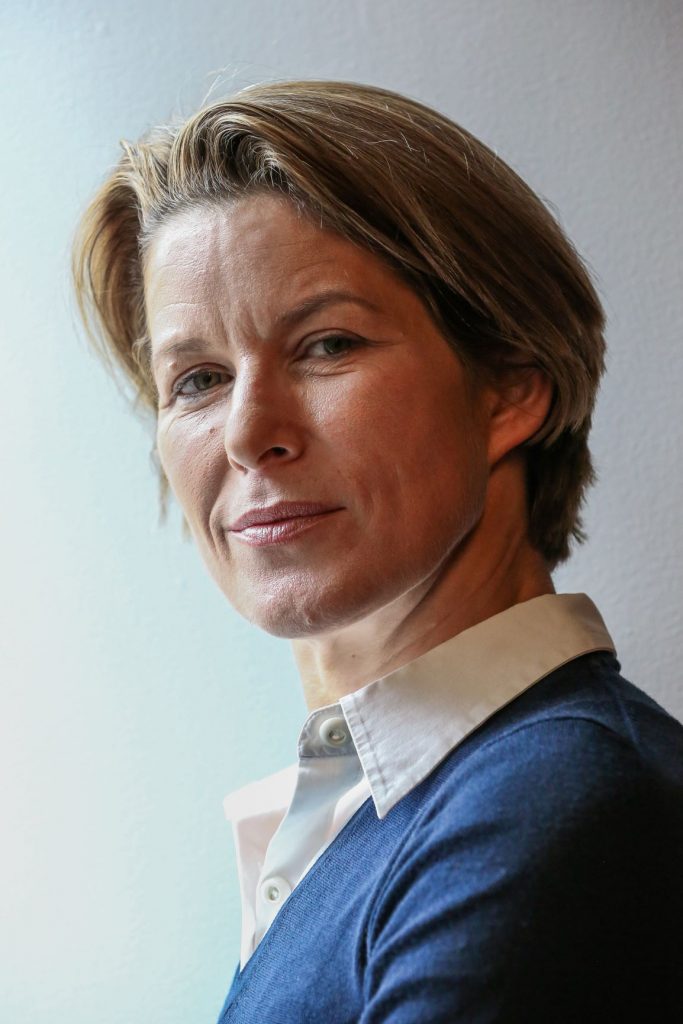
Stephanie has been both an economist and an economic journalist — she joined Bloomberg in 2017 and now does both, leading Bloomberg Economics and following a lifelong passion to demystify the global economy for a wider audience.
In what way have you broken glass ceilings or conventions? What challenges did you face, and how did you overcome them?
When I became the BBC’s Economics Editor, I was the first woman to occupy a specialist editor job. Happily, there have been plenty more since then, and in general I would say that economics has become a little less male-dominated over the course of my career. In a previous role, I was aware that I was paid much less than several male colleagues in similar roles. That’s a challenge I failed to overcome, but overall I don’t feel I have been held back by my gender. If anything, it has given me an edge — it’s striking how many of the major global banks now have female chief economists.
What advice do you have for future convention- and ceiling-breakers?
When you’re making a case for yourself, don’t start with the skills you don’t have. I thought it was just an outdated stereotype until I started interviewing women and men for jobs. So many women really do lead with the stuff they can’t do. It’s extraordinary.
Vandna Dawar Ramchandani, Singapore
“Understand and accept that every person and situation is different, so be empathetic and encouraging, and build trust so women feel empowered to share and take risks.”
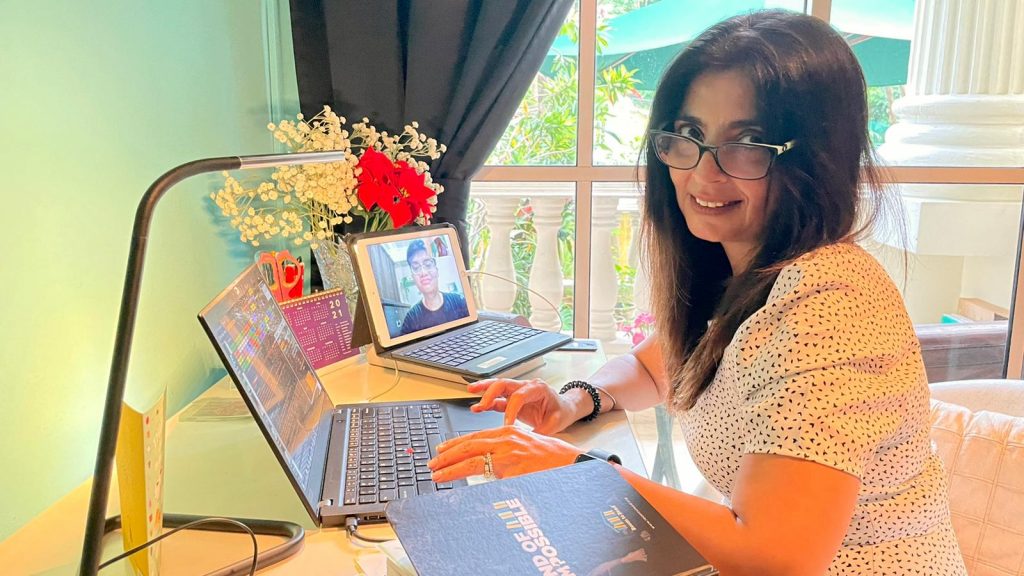
Vandna was born and raised in India. She joined Bloomberg in 1997 as a Terminal Sales rep, while living in Jakarta, Indonesia, and is now leading Corporate Philanthropy for APAC.
In what way have you broken glass ceilings or conventions? What challenges did you face, and how did you overcome them?
In Asia, particularly in India, a woman’s role is primarily expected to be that of a home-maker. I was committed to growing my career — even after having a family — taking on additional responsibility and relocating. When I first took on the roles of APAC Global Data Manager and then Singapore Office Committee chair, the first female in those roles, I did feel nervous about the step up, but there is so much support at Bloomberg, women just need to believe in themselves and lean in.
The biggest challenge is creating a balance that works for you, and often managing your guilt as a mum. There are no shortcuts so you start to run your life through “to-do” lists and constantly prioritize. My social life and personal time became secondary; my work and family were the priority. I wanted to live the life I dreamed of for my daughter and “walk the talk.”
What strengths do you believe your identity and experiences bring to your professional and personal life?
Authenticity, drive, hard work, empathy, and the desire to constantly challenge the status quo! Multi-tasking is not a choice, so you just become good at it. You learn to problem-solve and be creative, which lends itself wonderfully to a career at Bloomberg.
Nita Ditele-Bourgeois, New York
“Take risks and embrace failures. Be determined, never settle, and let your skills speak for themselves; not your gender.”
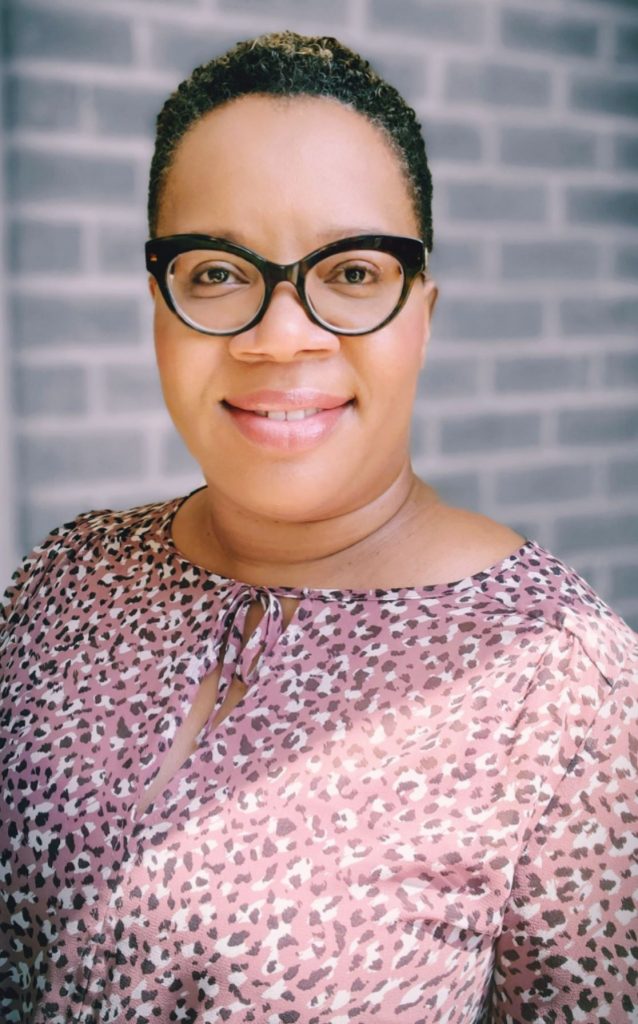
Originally from the South, Nita was raised in New York at the heart of a family that fostered continuous learning. She joined Bloomberg in 2007 as a Legal Negotiations Specialist, and is now a Product Operations manager in Enterprise Data.
In what way have you broken glass ceilings or conventions? What challenges did you face, and how did you overcome them?
Last year, after 13 years in Legal, I joined Enterprise Data. I saw an opportunity to leverage transferable skills, challenge myself, and grow. I wanted to be part of an exciting journey with the business from a different vantage point.
After encountering gender stereotypes and micro-aggressions throughout my career, I’ve found that the confidence and determination instilled at young age provided me the resilience and fortitude to address challenges head-on.
What strengths do you believe your identity and experiences bring to your professional and personal life?
Active listening has made the biggest impact. It takes time and intentionality, but the outcomes are enormous: positive engagement, sharing ideas, productivity, and stronger communication between individuals.
Celine Shi, Shanghai
“My experience has really been about breaking ceilings in my own mind.”

A native of Sichuan, China, Celine joined Bloomberg Analytics in 2011 in Singapore before taking on the challenge of expanding team coverage in Beijing. She now manages buy-side product specialists in Shanghai.
In what way have you broken glass ceilings or conventions? What challenges did you face, and how did you overcome them?
Early in my career, I didn’t want to draw attention to my sexual orientation, as I truly believe it has no relevance to how well someone performs at work. I kept my identity as a queer woman to myself, even though Bloomberg has been very supportive and open about our LGBTQ community. I later realized that this secret impacted how comfortable I was with colleagues and friends — I wasn’t being myself. I came out in 2017 and was able to fully embrace my friendships and work relationships, which helped me become more confident and perform better.
What advice do you have for future convention- and ceiling-breakers?
Do not set your own glass ceiling. Many of the women I know feel less confident about opportunities and question themselves: Am I really qualified for this? Do I have what it takes? We should be more confident in the different values and experiences we bring, and give ourselves a chance to be seen.
Deanna Hallett, London
“Seek out individuals and groups of people who will support you, lift you up, challenge you, and affirm your identity and your goals — no one can reach that glass ceiling alone.”
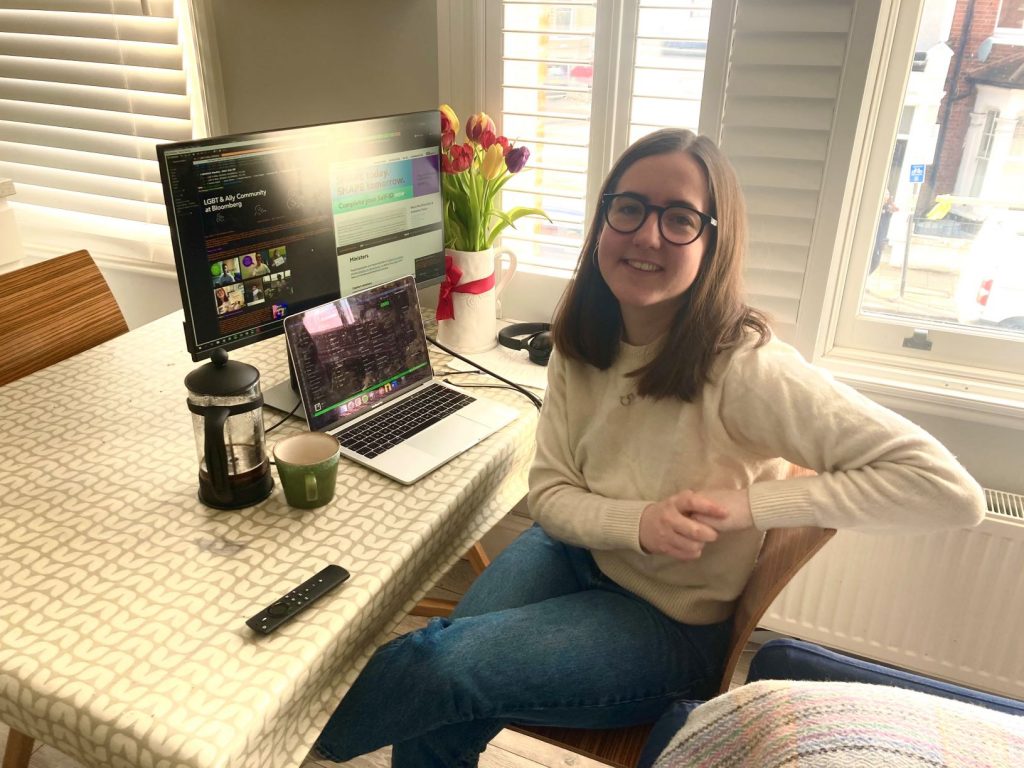
Deanna interned for Bloomberg twice before joining full-time after graduating university in 2019. She currently works in UK government and regulatory relations and is the co-lead for the LGBTQ+ and Ally Community in EMEA.
In what ways have you broken glass ceilings or conventions?
I was the first woman in my family to apply to university, the first to run for local councillor, the first to move abroad, and the first woman to come out as LGBT+ in my family. I faced a lot of challenges growing up, including poverty, and psychological and physical abuse from my father, which was particularly acute when I came out as gay. More broadly, I grew up in an environment where I was just expected to manage, have kids, and then become a full-time mum. It was difficult pursuing my own goals and independence when it didn’t marry the view of what my family expected.
What can our colleagues and communities to do become better allies to women in the workforce?
Actively listen. It’s only by taking into consideration people’s experiences that we can ensure the glass ceiling is shattered for all women — particularly LGBT+ women and women of colour, who are too often left behind.
Click here to read the full article on Bloomberg.


To create products that serve increasingly diverse customers and solve a wider range of social problems, technology companies need women engineers. However, only 25 percent of math and computer science jobs in the United States are filled by women, and one-third of women in the U.S. and China quit these jobs mid-career due to factors like social isolation, a lack of access to creative technical roles and difficulty advancing to leadership positions.
At Bloomberg, we’ve established a company culture that supports gender equality in a multitude of ways – from company-wide Diversity & Inclusion business plans to a newly expanded family leave policy. But we know that’s not enough. In recent years, we’ve adopted a system-wide approach to increasing the number of women in technical roles, taking steps to remove barriers to advancement both inside our organization and beyond Bloomberg, supporting female talent from middle school through mid-career.
While the number of women in technical jobs at Bloomberg is growing, we’re committed to making progress faster and completing all the steps needed to solve the equation. Here are some of the ways we’re tackling this important deficit – and making quantifiable change.
Early engagement
Bloomberg supports organizations that help increase women’s participation in STEM and financial technology, exposing students to various career options through Bloomberg Startup and encouraging our female engineers to engage with the next generation of talent.
Collaboration, creativity, and a love of problem-solving drew Chelsea Ohh to the field of engineering. Now she works at Bloomberg as a software engineer team lead, helping to provide critical information to financial decision makers across the globe.
Recruitment
We target our entry-level engineering recruiting efforts at colleges that have achieved or are focused on gender parity in their STEM classes. And because not all the best talent come from the same schools or have the same experiences, Bloomberg actively seeks women engineers with non-traditional backgrounds or career paths.
Talent development
Women engineers can sharpen their technical skills through open courses, on-site training sessions, and business hackathons held throughout the year. Bloomberg is committed to inspiring our female employees, eliminating barriers like impostor syndrome, and encouraging them to pursue opportunities in engineering.
Community & allies
To strengthen its network of female engineers, global BWIT (Bloomberg Women in Technology) chapters organize more than 150 events, mentoring sessions, and meet-ups a year. The community also engages male allies and advocates, sharing strategies to help them support their female colleagues.
Click here to read the full article on Bloomberg.


In a historic first, Karine Jean-Pierre has become the first Black woman and the first openly gay person to become the official White House Press Secretary and Assistant to the President. Jean-Pierre was promoted to the position, formerly serving as the Principal Deputy Press Secretary and Deputy Assistant, after Jen Psaki resigned as the Press Secretary after fulfilling her one-year commitment.
“I am proud to announce that Karine Jean-Pierre will serve as the next White House Press Secretary,” President Biden said in an official statement, “Karine not only brings the experience, talent and integrity needed for this difficult job, but she will continue to lead the way in communicating about the work of the Biden-Harris Administration on behalf of the American people. Jill and I have known and respected Karine a long time, and she will be a strong voice speaking for me and this Administration.”
Born in Martinique and raised in New York, Jean-Pierre is a graduate of Columbia University, where she received her Master’s Degree in Public Affairs. Besides being the Principal Deputy Press Secretary and Deputy Assistant to the President, Karine is no stranger to working in politics or with President Biden. A long-time advisor to President Biden, Jean-Pierre served in senior communication and political roles in the Biden Administration, the Biden campaign and to then-Vice President Biden in the Obama Administration before taking on her most recent government roles.
Prior to her role on the campaign, she served as Chief Public Affairs Officer for MoveOn.org and an NBC and MSNBC Political Analyst. Jean-Pierre served as Regional Political Director for the White House Office of Political Affairs during the Obama-Biden administration and as Deputy Battleground States Director for President Obama’s 2012 re-election campaign. She served as Southeast Regional Political Director for President Obama’s 2008 campaign, Deputy Campaign Manager for Martin O’Malley for President, Campaign Manager for the ACLU’s Reproductive Freedom Initiative and Deputy Chief of Staff and Director of Legislative and Budget Affairs for two members in the New York City Council.

Previously, she worked at the Center for Community and Corporate Ethics, pushing major companies to change their business practices, and is a published author.
“This is a historic moment, and it’s not lost on me,” Jean-Pierre stated of her appointment, “I understand how important it is for so many people out there, so many different communities, that I stand on their shoulders, and I have been throughout my career.”
Many took to social media to celebrate the incredible firsts that Jean-Pierre was accomplishing, including former Press Secretary, Jen Psaki, who tweeted her praise to Jean-Pierre’s character, work ethic and appointment:
“She is passionate; she is smart and has a moral code that makes her not just a great colleague, but an amazing Mom and human,” Psaki tweeted, “…she will be the first Black woman and the first openly LGBTQ+ person to serve as the White House Press Secretary. Representation matters and she will give a voice to many, but also make many dream big about what is truly possible.”
Sources: The White House, CNBC


By Danielle Jackola
Remote work has become increasingly popular, and while many companies utilized it as a temporary solution during the pandemic, others have realized the endless benefits of maintaining a remote workforce. Working remotely doesn’t necessarily mean you’re doing work from your home; it represents the freedom to work from a variety of locations, including on the road while you travel, from a coffee shop or somewhere that inspires you.
Whether you are considering remote work or need some strategies for keeping sane while working remotely, here are some tried and true work-from-home tips to set you up for success.
The Power of Routine
Creating and maintaining a routine will help you work efficiently and effectively. If starting your day without a cup of coffee in hand sounds like torture, set a timer on your coffee maker, so it’s ready to go. Consider the steps you need to be prepared and focused as an employee. This includes choosing a bedtime and wake-up time that supports your schedule and sleep requirements. Allow extra time for things like feeding pets, getting kids off to school or checking personal emails.
Allowing yourself adequate time to complete and shift from one task to another before you sit down for work will let you start your workday energized, focused and ready to thrive in your role. Think about the time you saved by not commuting to an office and use it to your advantage.
Maintain your Rituals
Daily rituals are an effective tool for creating balance in your personal and professional life, but they also allow you to transition in and out of work smoothly. When you wrap up your workday, tidy your workspace, shut everything down and if you’re able to, separate from your job so you can shift your energy to your personal life. Taking a walk after work to get fresh air and exercise is the perfect way to use the adjustment time to your advantage. If you live with others, define roles in your house so everyone knows what to expect and how they can contribute to fostering a low-stress environment.
Dress for Success
While the idea of working from bed in pajamas is tempting, consider the impact on your sleep cycle and your body’s ability to recognize the signals that it’s time for rest. Your bed should be a sacred space for rest. When you start your day, select attire that aligns with your job and projects confidence. As a professional, leggings and the college sweatshirt you have quite literally worn to pieces aren’t the best options. You shouldn’t be looking for places to hide when a last-minute video conference pops up. If you’re not comfortable on-screen, you need to reconsider your attire.
Dedicate a Workspace
Design a space that allows you to be organized and productive. Even with space limitations, you can choose a spot that fosters both creativity and concentration and supports you in bringing your A-game every day. Give yourself the gift of a dedicated workspace that will enable you to focus on work.
Connectivity is Crucial
Test your internet and cell phone connections throughout your home. It’s critical to perform your job as well remotely as you would in-house at your company. If your signals are weak, find ways to improve them, like asking your cell provider for a signal booster or increasing the speed of your internet service.
Gather Supplies
Consider the type of work you do and what you need to perform your position effectively. Do you need a second computer screen, specialized software, do you maintain paper files, or do you need a dedicated printer? Your role will help you determine the tools you need to be successful. Ask your employer if they provide these tools or if they are the responsibility of their employees.
Stay Connected
Maintain contact with your colleagues and communicate your preferences for communication throughout the day. Do you prefer to receive texts, emails or a phone call when something urgent arises? Does your team utilize weekly or even daily meetings to keep everyone connected and up-to-speed?
Take Breaks
The secret to maintaining sanity while working remotely? Schedule time for lunch and mini breaks, so you give your brain a break. You’ll come back refreshed and ready to crush your goals for the day.
Reflect and Adjust
Periodically consider what is and isn’t working in your remote work environment. Don’t be afraid to acknowledge if something isn’t serving you and then determine the steps you can take to adjust your situation. By allowing yourself the ability to be flexible, you can make changes along the way that keep you thriving as a remote employee.